Photography in Mykonos is a professional production on an island where three things set the schedule: light, crowds and wind. In practice, that leaves two genuinely usable windows in the day, roughly 90 minutes after sunrise and 90 minutes before sunset. We do not use the middle of the day, especially in summer, for portraits or shots involving people.
Below we explain what each location asks for and how we realistically organise a day of photography or filming on the island.
At a glance
- Hours with good natural light: about 90 minutes after sunrise and 90 minutes before sunset. Midday hours in summer are practically unsuitable for photography.
- Crowds: Mykonos Town is relatively empty before 09:00. From 09:30 onward, the arrival of cruise ships increases foot traffic, peaking around 11:00.
- Best season: May and the period from late September to October offer softer light, fewer people and lighter winds.
- Realistic target: 2–3 locations per day.
When the light really works in Mykonos
Light is not what we lack in Mykonos. Usually we have too much of it. The white walls reflect the sun strongly and, when it sits high in the sky, surfaces blow out easily and lose their texture. At the same time, harsh shadows fall across faces. Whatever detail is lost during the shoot, we cannot bring back in post-production.
That is why we work early in the morning, shortly after sunrise, and late in the afternoon, shortly before sunset. At those hours the light also falls at a lower angle and the white walls reflect it strongly.
We always count on the 30 minutes after sunset as well. The white walls still hold a warm tone while the sky turns deep blue. This is the hour when Little Venice works best, with the bar lights on and the sky still holding some daylight.
We adapt the schedule to the season too. Sunset in Mykonos is not the same in late June as in mid-October. A schedule that works at 20:00 in June leaves us without natural light in October.
Locations and what each requires
Mykonos Town
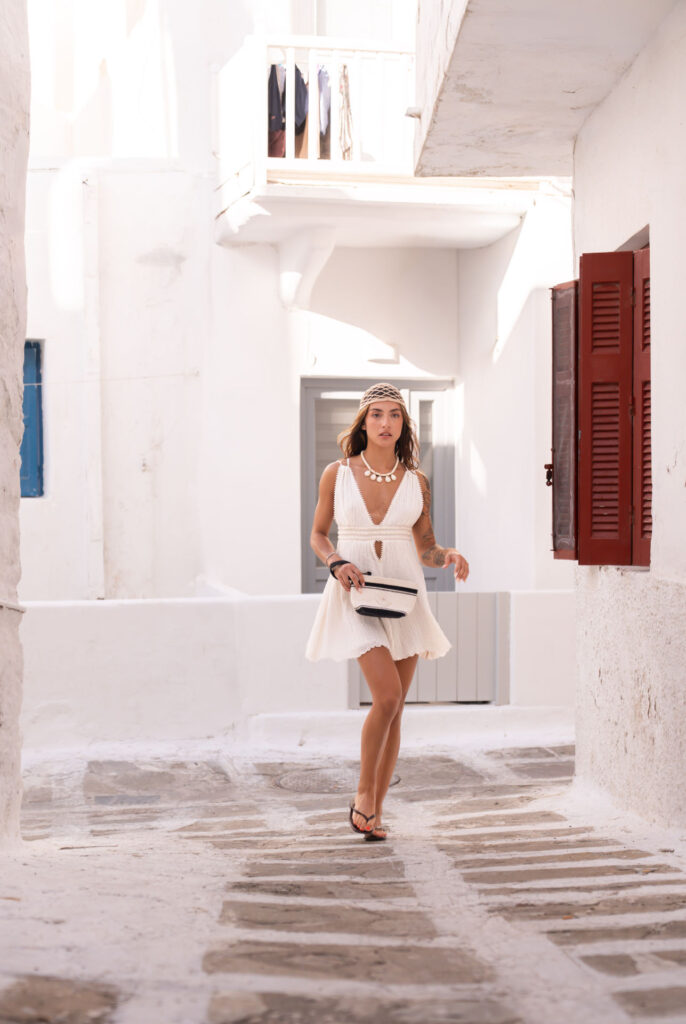
The alleys of Mykonos Town are the island’s most recognisable setting and, at the same time, one of the most demanding places to photograph. We shoot them early in the morning: before 09:00 the streets are almost empty, while from 11:00 onward, especially in summer, the crowds make any clean shot without passers-by difficult.
Little Venice
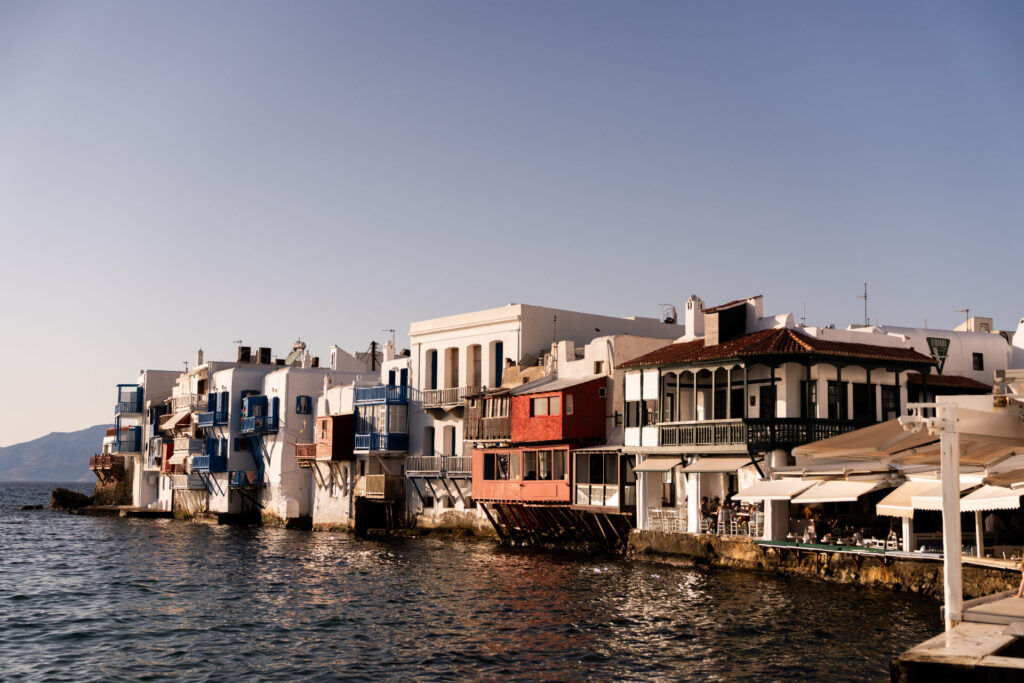
The houses built over the water add colour and depth to the image, elements we do not find easily elsewhere on the island. We keep Little Venice for the end of the day: the hour before sunset, when the sun hits the façades from the side and brings out their detail, and the 30 minutes after it for the more cinematic shots.
The Windmills
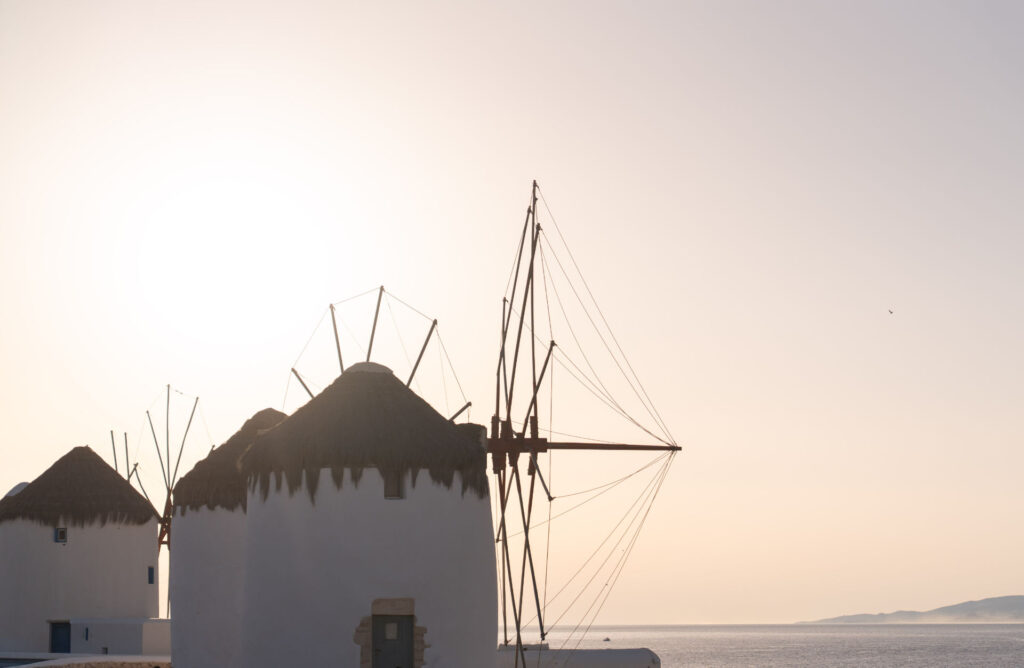
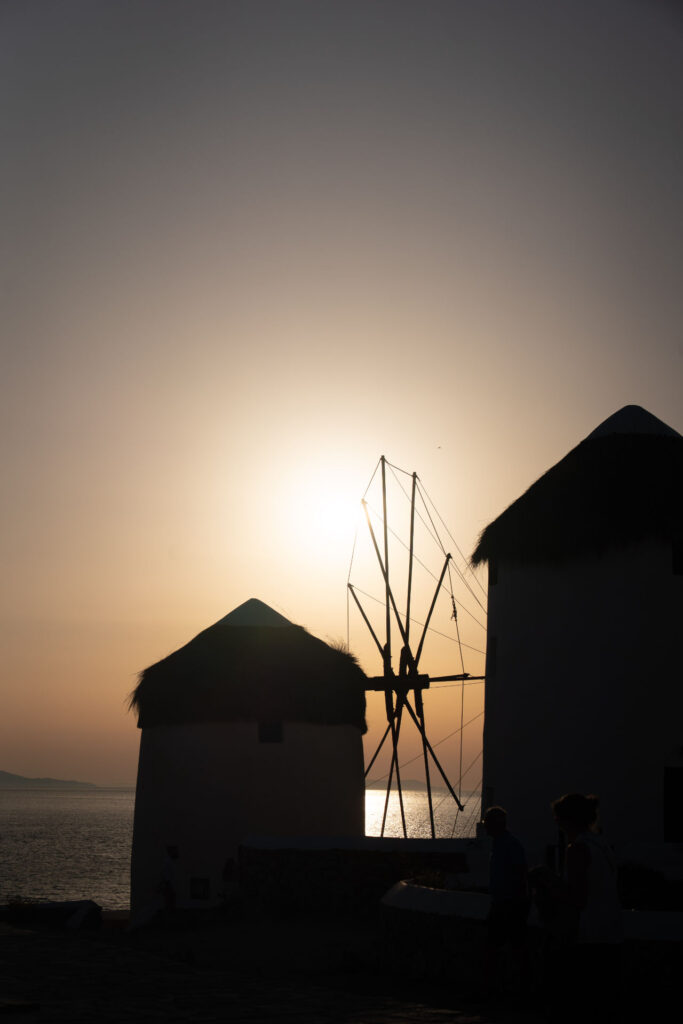
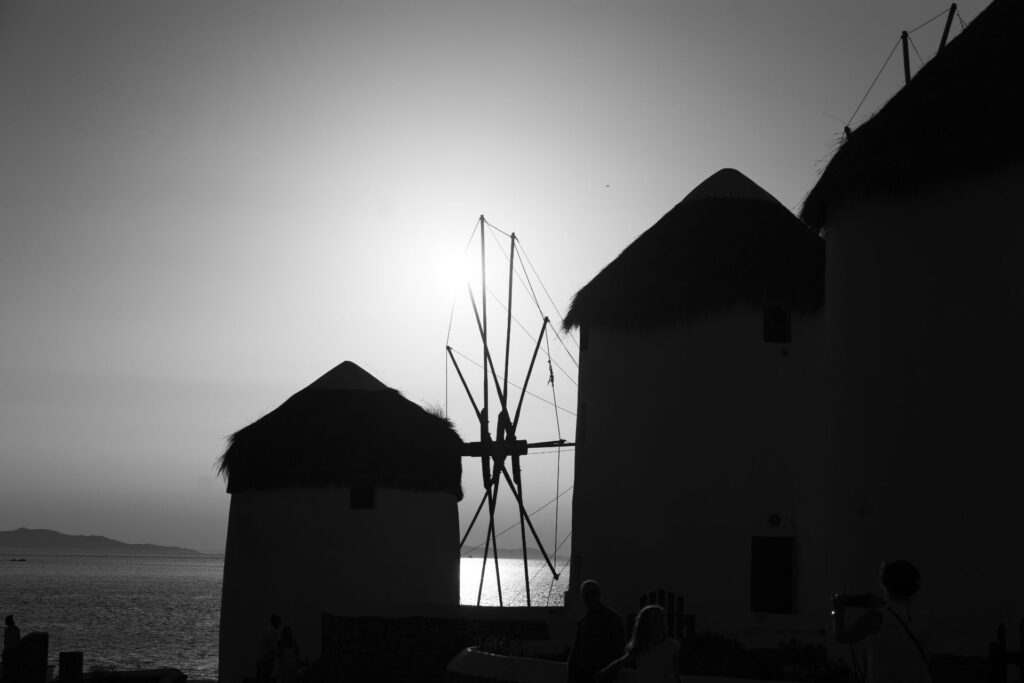
The windmills are among the most photographed spots in Mykonos, which makes them among the hardest to photograph with a fresh eye. At sunset, the strong backlight gives ideal conditions for silhouettes and clean outlines.
Beaches and villas
The southern beaches offer abundant light and a clear horizon. How exposed each beach is to the wind, we check per spot and per day. Private villas and hotels solve two problems for us at once: they give us a controlled environment and usually come with natural shade. That is why we often suggest them as a first choice for corporate and brand productions. For any villa or hotel, we speak to the owner or the management in advance.
Wind, crowds and movement
We account for wind when we plan the schedule, days before the shoot. It affects hair, fabrics, equipment stability and, in many cases, whether we can fly a drone.
On a fashion shoot the wind can work in our favour, because it adds movement to the clothing. It just has to be a decision, part of the creative direction, rather than something that catches us out.
Crowds in Mykonos Town follow a predictable rhythm. The alleys fill up when cruise ship passengers arrive and empty again in the afternoon, when they head back to the ships. We build the schedule to start early in the morning and continue late in the afternoon, inside those quieter windows.
Moving between locations takes more time than the map suggests. Mykonos Town is pedestrian-only, the car stays outside the centre, and every change of location means driving, walking and setting the equipment up again. That is why we book two to three locations per day.
What kinds of photography are done in Mykonos?
- Weddings and destination weddings. These make up a large part of the professional photography activity on the island. Ceremony and reception venues, however, have their own schedules and restrictions. You will find more in our guide to the top wedding venues in Mykonos.
- Fashion and brand productions. In a fashion or brand shoot, Mykonos does not simply work as a backdrop. It becomes part of the brand’s identity and directly influences the aesthetic of the production. An example from our own work: the fashion shoot for Ipatia Boutique’s new collection, with three looks and three locations in one day.
- Corporate events and incentive trips. This category includes conferences, corporate dinners, events and incentive programmes held in hotels and other venues on the island. We work with the same approach we apply across Greece in corporate photography for businesses.
- Family and couple sessions. Short sessions of 60–90 minutes, usually in one or two locations.
Each category comes with a different constraint. At a wedding the ceremony and the reception dictate the schedule, so the light is a given and we make the best of what is there. See how we approach wedding photography. On a brand shoot the opposite applies: we choose the light first and adapt everything else around it. At corporate events the constraint is discretion and speed, because the photography must never interrupt the flow of the event.
The technical side: what changes with this much light
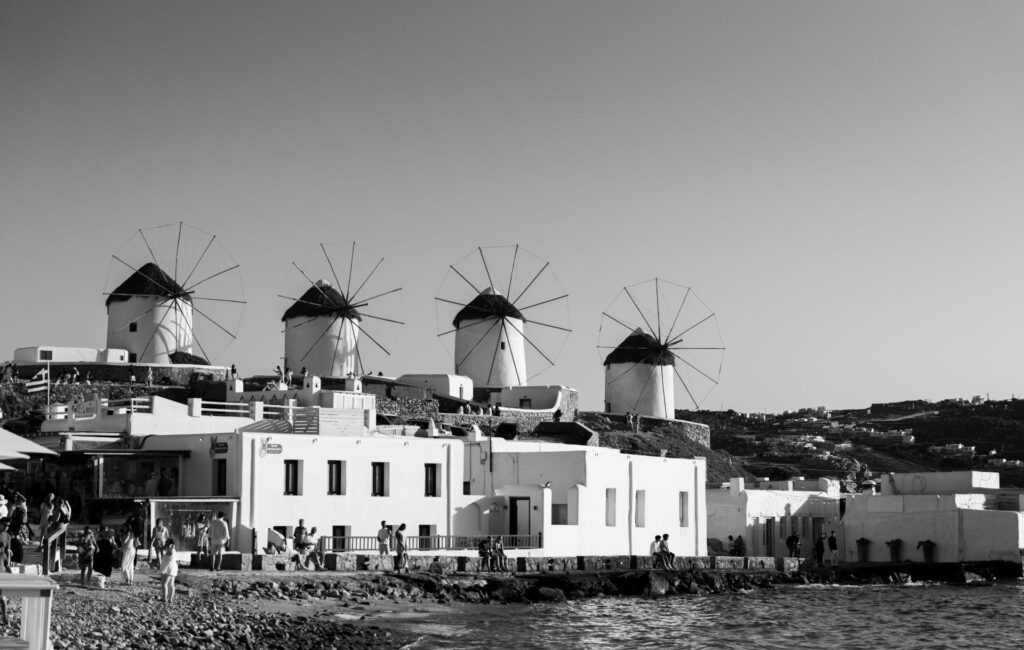
In Mykonos we almost always work with too much light rather than too little. That changes several of our usual technical choices.
At the windmills and in Little Venice we use the backlight in two ways. We either keep the subject in silhouette, for a stronger result, or bring in a battery-powered portable flash to light the face or the clothing. Since there is no easy access to power at these spots and the wind knocks stands over, we prefer a small light held by an assistant to large softboxes.
We choose the lens mainly according to the available space. In the narrow alleys of Mykonos Town we need a wider lens, because there is no distance to step back into. At the windmills, where the space is open, we use a telephoto for tighter shots that isolate the windmills from the rest of the landscape.
The three most common scheduling mistakes
- Too many locations in one day. The most common mistake. Five spots on the map usually become three in practice. We would rather cover two locations properly than rush through five and end up with half-finished results.
- Shooting with the sun high. Midday light in Mykonos is not simply less attractive; in an outdoor, white setting it is practically unsuitable for portraits. We set the hour first and build the schedule around it.
- No alternative for the wind. We do not leave the wind until the day of the shoot. It affects hair, fabrics, lighting and equipment stability. For every outdoor location we prepare a more sheltered alternative in advance, so the production carries on without major changes to the schedule.
What a production includes
The cost of a shoot in Mykonos does not depend on shooting hours alone. In the budget we also count crew travel and accommodation, vehicle rental on the island and the time post-production takes.
What affects the cost most is the size of the crew. When a stylist, a lighting assistant and a separate videographer are involved, both travel costs and coordination time go up.
One professional handling both photography and video in the same production is not the ideal solution for every project, but on small and medium-sized brand shoots it usually gives a better cost-to-result ratio.
We agree the delivery time from the start. We set the number of final edited images and the delivery date before the shoot day, not afterwards.
How we organise a shoot day
We always start from the end: we set the sunset time first, choose the locations that deliver at that hour, and calculate the transfers between them last.
When it happens the other way round, when five beautiful spots are chosen first and we then try to fit them into the schedule, the production ends up with half-finished shots in the wrong light.
A realistic day starts with a morning set in Mykonos Town, before 09:00, for empty alleys and fewer people. Then comes a break through the difficult midday hours, or work in a shaded, controlled space.
The afternoon set starts well before sunset and carries on for a while after the sun goes down. In practice we plan two main sets, two to three locations and, for each set, one key shot that has to come out.
When the shoot includes video, we film both in parallel rather than one after the other. That way photography and video come out on the same set and in the same light, with a common colour and aesthetic identity. When the material is shot on another day or by another crew, that consistency rarely comes out.
Frequently asked questions
What is the best time of year for photography in Mykonos?
May and the period from late September to October give you the best combination of conditions: softer light and significantly fewer people at the popular spots.
We work normally in July and August, but with stricter planning around the two windows of good natural light.
How many locations can we realistically cover in one day?
Realistically, two to three. What limits us is mainly the time spent moving, not the time spent shooting.
Mykonos Town is pedestrian-only, the car stays outside the centre, and every change of location means driving, walking and setting up again. On a five-location schedule, half the shots come out rushed or in unsuitable light.
What if it is windy?
We account for the wind at the planning stage, not at the last minute. It affects hair, fabrics, equipment stability and whether we can fly a drone.
On a fashion production we use it deliberately, to add movement to the clothing. In other cases we move to a more sheltered spot or change the order of the sets within the day.
Can photography and video both be covered on the same day?
Yes, and this is usually the best solution. When we shoot the photographic and video material in parallel, on the same set and in the same light, they share a common colour and aesthetic identity and we do not have to colour-match them later in post-production.
It takes proper organisation of the sets, so that equipment changes do not take away from the available shooting time.